
Auburn Resident Lookup Evidence
No official master list identifies every Auburn resident. The dependable route is a question-specific record trail. The county parcel tools can identify a recorded owner and a tax-map location. A recorded deed can place a named party in a transaction. Court, voter, vital, cemetery, and probate records each answer narrower questions, often with limits on who may see a full file. Preserve the source date and distinguish a resident, owner, boarder, legal party, and mailing address rather than treating those terms as interchangeable.
| Record | What It Confirms | Where | Access |
|---|---|---|---|
| Parcel and assessment | Recorded owner, situs, tax-map location, and transfer context | Cayuga County Real Property Services / PROS and GIS | Public web and office route; owner is not proof of occupancy. |
| Recorded document | Grantor or grantee, recording date, book/page, and legal description | SearchIQS and the Cayuga County Clerk | Free index; image, historical-book, or clerk route can differ. |
| Voter query | A possible registration match for the voter using the official query | New York Voter Lookup | Individual self-service only; protected identifiers stay outside the result path. |
| Court index | A public case path, case type, index number, and docket route | NY eCourts / WebCivil and NYSCEF | Portal coverage varies; sealed and restricted matters remain closed. |
| Vital record | An eligible birth, death, marriage, or genealogy event | Auburn Registrar, NYS DOH, or NYS Archives | Copies have relationship, age, and death-status rules. |
Use parcel and deed evidence for a transaction question, a court file for a case question, and the vital route for a family event. Current owner is not current occupant. A successful name match still needs a second anchor, such as a dated address, middle initial, relative, legal description, or case index number.
Verify an Auburn Resident
A name becomes more reliable when separate first-party records point to the same person and date. Start by writing down the full name exactly as found, including initials, suffixes, alternate spellings, and an older street name where relevant. Auburn mailing addresses can also fall in Fleming, Throop, Owasco, Sennett, or Aurelius, so confirm the municipality before selecting a local custodian. Mark an unresolved same-name hit as unresolved rather than forcing it into a household.
- Locate the best dated starting record. For a property question, note the parcel municipality and tax-map number from GIS or PROS before using the owner name.
- Check the party name and spelling variants in the appropriate court or recorded-document index. Keep the returned date, document reference, or court index number.
- Compare one independent anchor, such as a dated address, spouse or relative, deed legal description, birth or death year, or public case detail.
- Request the releasable file from the clerk or registrar when an official copy is needed. Record whether the result was found, not public, outside coverage, or not evidence of residence.
For a historical name or address, the dated volumes in the Auburn city directory collections can provide another anchor. They are snapshots from a particular edition, so an old entry should not be read as a present address.
- Docket
- A court’s running case record, used to follow filings, events, and the route to the originating clerk.
- Index and image
- An index identifies a record and its reference; an image is the scanned document or filing, which may have a different access path.
- Certified copy
- A custodian-issued copy with the certification needed when an ordinary search result is not sufficient.
Auburn Court Lookup Records
Use NYSCEF guest search when the forum and case type fit its coverage. Its published controls include index or claim number, party or attorney name, organization, tax-cert/SCAR block and lot, new cases, county, case type, and date range. NYSCEF and WebCivil are not one universal index. A case may be sealed, confidential, delayed, excluded by category, or held outside the web view. Auburn City Court, Cayuga County Court, Family Court, and Surrogate’s Court have different jurisdiction and access rules.
| Result or search item | How to use it |
|---|---|
| Party or attorney name | Use as a search field and compare against another dated identity anchor. |
| Index or claim number | Save it exactly. It identifies the court matter for a clerk inquiry. |
| County, case type, and date range | Limit the search to the court and time period that fit the question. |
| Docket link | Use the docket route to identify filings, then ask the originating clerk about a releasable copy or certification. |
For a missing or truncated web result, use the court clerk or public-access route, subject to sealing. A court appearance does not establish a home address. Adoption, Family Court, divorce, youthful-offender, juvenile, mental-health, substance-use, victim, and some Surrogate’s materials can be restricted. Redact protected numbers from any notes or excerpts.
Auburn Voter Lookup Limits
New York Voter Lookup is a self-service check for a registered voter, not a street-wide Auburn resident list. The live query requires Cayuga County, last name, first name, date of birth in MM/DD/YYYY format, and ZIP Code. A non-match can result from an update, confidential status, eligibility, spelling, or search parameters. It should never be reported as proof that a person is not registered.
| Required field | Official format or boundary |
|---|---|
| County | Select Cayuga County for an Auburn query. |
| Last and first name | Both are required text fields. |
| Date of birth | Required as MM/DD/YYYY. |
| ZIP Code | Required ZIP associated with registration. |
Election Law §§3-103(5) and 3-220 limit statewide file use and protect driver-license, non-driver-ID, Social Security, signature, and confidential-voter information. A voter-file request follows the State Board’s election-purpose process, not a public bulk-export tool. The Cayuga Board of Elections contact found in county guidance is 315-253-1285.
Auburn Vital Records Routes
Vital evidence depends on the event jurisdiction and the type of copy requested. The Auburn Registrar of Vital Records holds city events, while a nearby town with an Auburn mailing address may keep its record with that town clerk. Auburn marriage records are limited to licenses purchased in the city. Certified copies follow eligibility rules. Genealogy searches are staff-performed searches for qualifying older, deceased-person records, not an open online name index.
The city registrar offers an in-person route and directs certified orders through VitalChek. State options include a NYS DOH mail request, online or telephone ordering where offered, and genealogy submission through the instructed Archives or DOH mail or drop-off route. DOH says email cannot provide or verify a vital record. The official Auburn vital-records information identifies the local custodian and the distinction between a city event and an Auburn postal address.
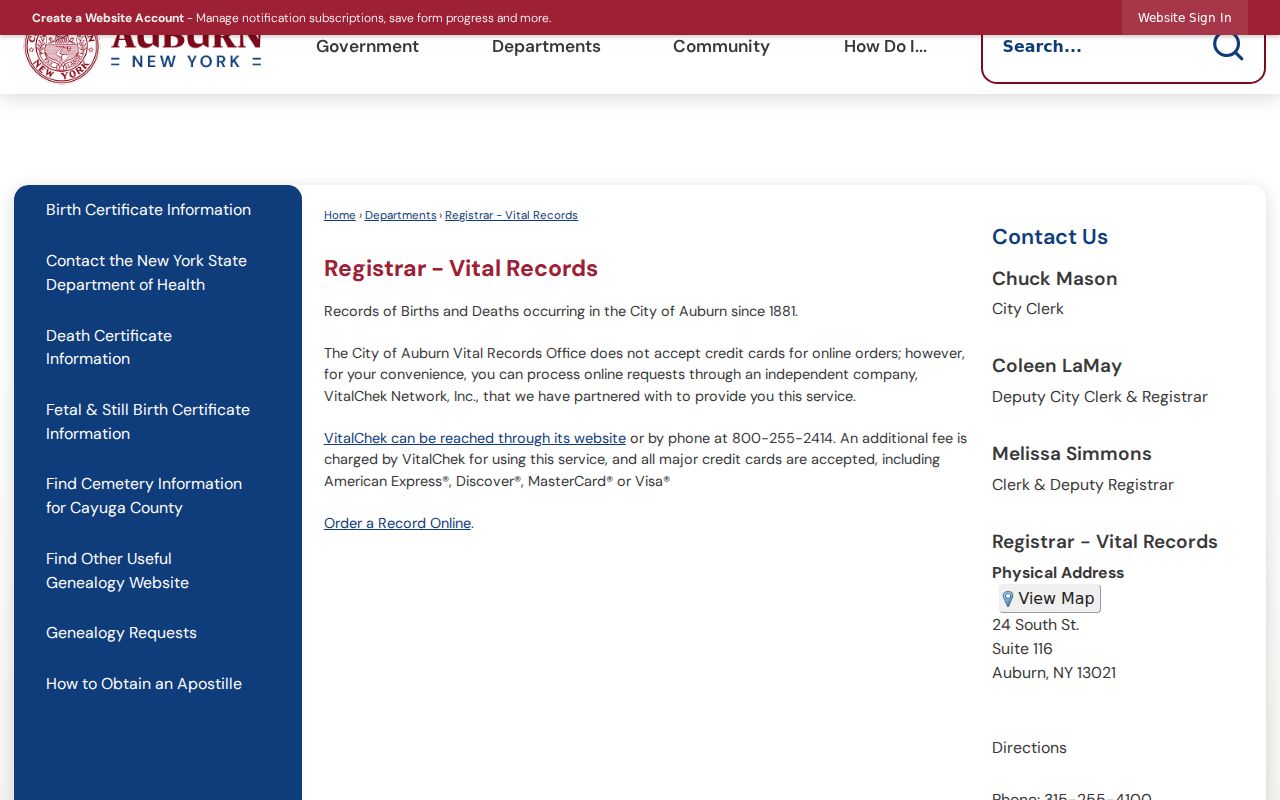
The registrar image supports using the city’s own ordering route before assuming a statewide office holds the particular event.
The New York State Department of Health vital-records service provides the statewide layer and points to the current request channels. NYS Archives holds historical indexes outside New York City for births and marriages from 1881 and deaths from June 1880. A certified copy, a genealogy search, and an index finding serve different purposes and can have different timing.
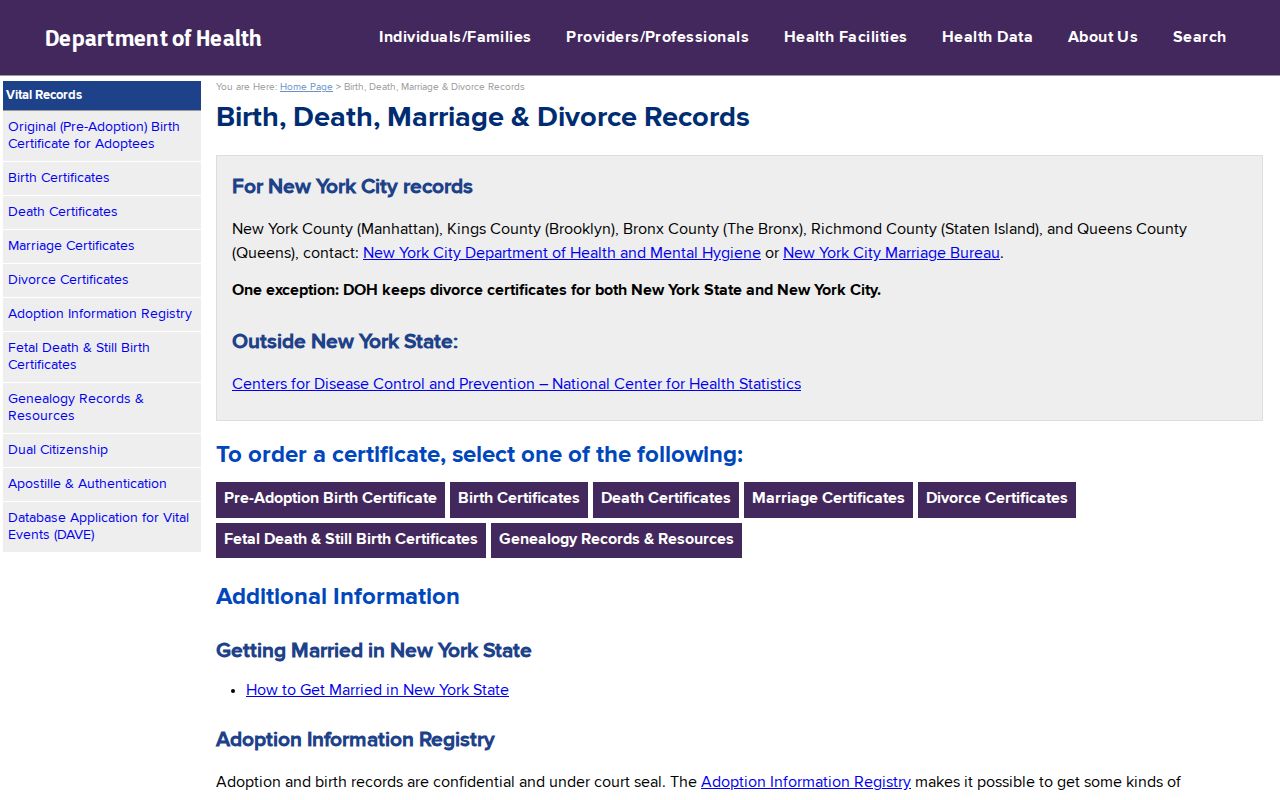
The state image is a useful reminder to check the live eligibility and request instructions instead of relying on an old form.
Auburn Vital Record Gaps
Auburn birth and death records begin in 1881, but statewide mandatory registration was not dependable until 1914. An early search failure can therefore reflect coverage rather than a missing event. Auburn’s older death records may omit parents before March 1907, and spouse information did not begin until late March 1920. Those field changes matter when comparing two records with similar names.
Local genealogy thresholds are 75 years for births, 50 years for deaths, and 50 years for marriages when both spouses are deceased. The city publishes fee bands for a staff search and states its no-refund and no-record-report terms. Pair an older vital result with a cemetery, obituary, directory, census, deed, church, military, or County Historian source before drawing a family conclusion.
Auburn FOIL Record Fallback
When a nonconfidential municipal or county record is not online, send a narrow written request under the New York Freedom of Information Law, Public Officers Law Article 6, §§84-90. Name the custodian, record type, address or party, date range, and preferred electronic format. Ask for reasonably segregable material if a whole file contains private information. FOIL is not a way around court sealing, voter protections, or certified-vital-record eligibility.
- Route a permit, complaint, or certificate-of-occupancy request to Auburn Code Enforcement; route a recorded instrument to the County Clerk; and route assessment material to Real Property Services.
- Keep the request, acknowledgment, and response dates. An agency generally must grant, deny, or acknowledge within five business days.
- If more than 20 business days after acknowledgment are needed, the agency must give written reasons and a date certain. An appeal generally must be filed within 30 days.
The County Clerk can also confirm current delivery and counter procedures at its official Clerk page. Office-building conditions can affect logistics, so check the current notice before a visit.
Auburn Resident Lookup Limits
Public access has firm boundaries. The New York Address Confidentiality Program can provide a substitute Albany mailing address for eligible participants, while actual addresses remain confidential except for specified lawful requests. It does not promise removal of older public records. Court files can be sealed or restricted, voter identifiers are protected, and DMV-derived addresses, utility customer lists, delivery data, private phone numbers, and protected victim addresses do not belong in a resident search.
Lawful use. Use Auburn records for personal research, genealogy, civic transparency, safety, and verified property questions. Do not use information to stalk, harass, intimidate, impersonate, or harm anyone.
For protection or an address-confidentiality question, use the official New York Address Confidentiality Program rather than publishing sensitive details or assuming a record can be removed everywhere.