
Auburn City Directory Collections by Access
Auburn city directories are strongest when the edition, page, and access route stay together. Seymour Library identifies a local run from 1857 to the present, while NY Heritage makes selected volumes available online. A directory is a yearly publication, not a continuous resident roll. The most useful result is therefore a page image or a shelf copy with its exact edition date, rather than a bare name transcription.
| Collection | Years | Where held | Access |
|---|---|---|---|
| Auburn city directories | 1857-present | Seymour Library | Library and local-history access |
| Digitized Auburn directories | 17 items, including 1879/80, 1890/91, 1910, and 1915 | NY Heritage | Free online page images |
| Auburn telephone books | 1940/41 and 1944/45 listed | New York State Library and local holdings | Fiche, film, or library route |
| Newspaper and yearbook companions | Newspapers reach the 1830s; yearbook span not verified | Seymour Library | Local collection and research help |
The online items are not a promise that every annual volume was digitized. Library holdings, microfilm, and statewide film listings cover gaps that a web search may miss. When an edition is absent online, preserve the year sought and ask for that volume or its nearest available neighbor rather than treating the gap as a negative result.
The digitized set is especially useful for comparing formats across the run. The 1879/80 item is associated with Wm. J. Moses, the 1890/91 item with Alonzo P. Lamey, and the 1910 guide and 1915 sample with Jas. W. Burroughs. Publisher changes can alter headings and shorthand, so a term found in one Auburn city directory should be checked against the abbreviation key and section layout of that same volume.
Auburn City Directory Shelf Access
Seymour Library brings the local shelf, newspapers, yearbooks, and historical databases into one route. Its genealogy resources identify Ancestry Library Edition for in-library use, HeritageQuest remote access for Seymour or Finger Lakes cardholders, microfilm scanners, and the History Discovery Center. The center is at 176 Genesee Street. Its posted local-history hours are Wednesday through Friday, 10:00 to 4:00, with a March closure and an appointment recommendation. Call 315-252-2571, extension 414, before a special visit.
Seymour Library’s genealogy page identifies the directory and newspaper resources available for Auburn research.
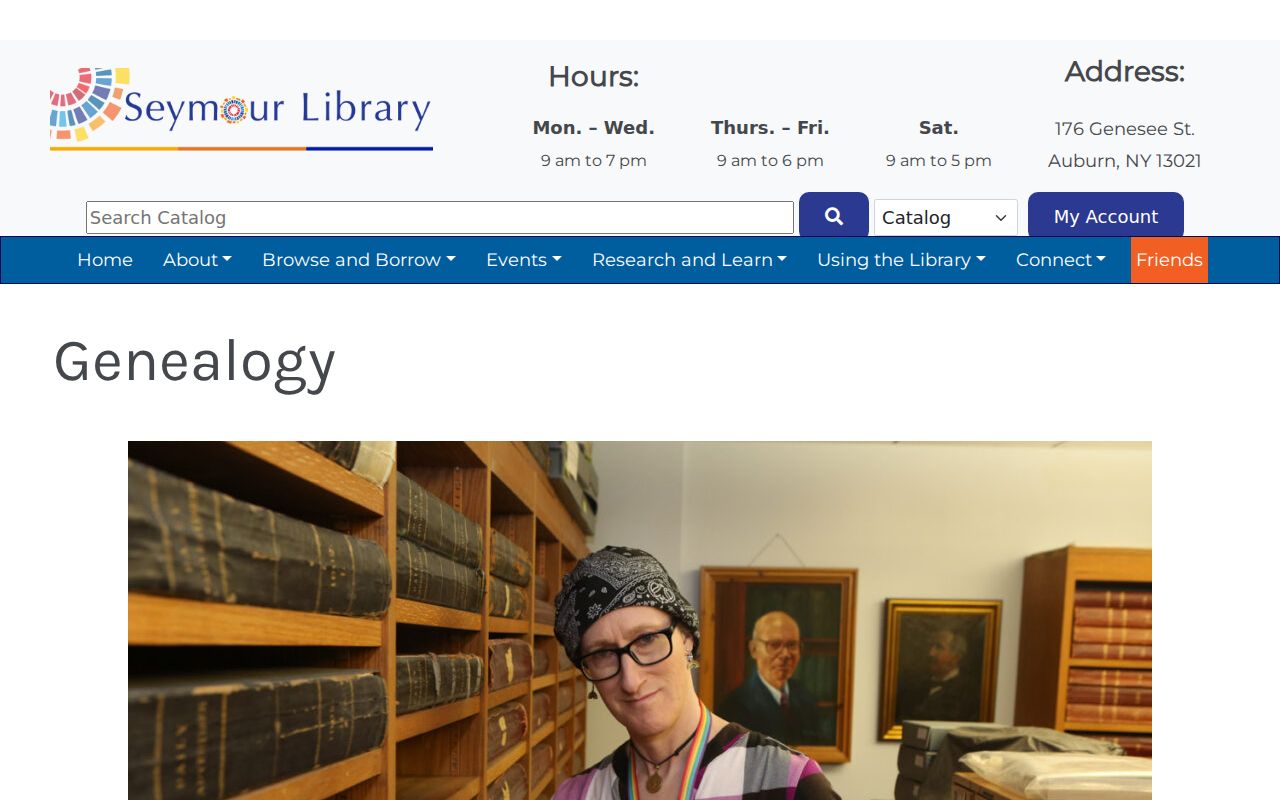
Library access supplies a practical fallback when a digitized directory page is unavailable or the Community History Archive is affected by its cloud migration.
The library’s local-history route also provides appointment guidance and a remote research form. Give staff the surname, the original street spelling, and the edition year. Those details are more useful than a broad request for every person at an address.
Seymour’s Auburn newspaper holdings add a separate check when a directory trail breaks. The collection includes Bulletin, Daily News or Bulletin, Advertiser or Journal, and Citizen runs, with older titles reaching into the 1830s. Search an initial, married name, street name, or the word “removed” with a date range. A notice can explain a move or death, but the directory page still remains the source for its own listing.
Reading an Auburn City Directory Entry
The 1890/91 Auburn volume, published by Alonzo P. Lamey for the year ending July 1891, shows why a full transcription matters. Entries can combine a name, a historical trade or business description, and more than one address clue. A married woman may be identified with “Mrs” and husband initials, and a widow notation can be a useful family lead. Keep the printed spelling, punctuation, and page number, even when a later record uses a different form.
| Name | Surname plus given name or initials; some entries identify a married woman or widow. |
|---|---|
| Historical role | Occupation, business, or employer shorthand as printed for that edition. |
| Address text | h means home or house, res means residence or resides, and bds means boards or boarding when used by the volume. |
| Owner or renter clue | The reviewed samples do not supply a verified owner or renter mark; use the separate property-owner section and deeds for ownership evidence. |
| Evidence marker | Edition year and directory page; “removed” reflects the compiler’s notation, not a current forwarding address. |
- Criss-cross directory
- A street-order section that can be read from an address toward listed occupants or businesses.
- Householder index
- A name or address aid that identifies the adult named for a household; Auburn editions vary, so check the volume’s own arrangement.
- Abbreviation key
- The printed key explains shortened terms such as
h,res,bds,emp, anddo; the 1910 key is near directory page 27.
The 1890 Auburn directory scan preserves the period’s residence, boarding, and business conventions.
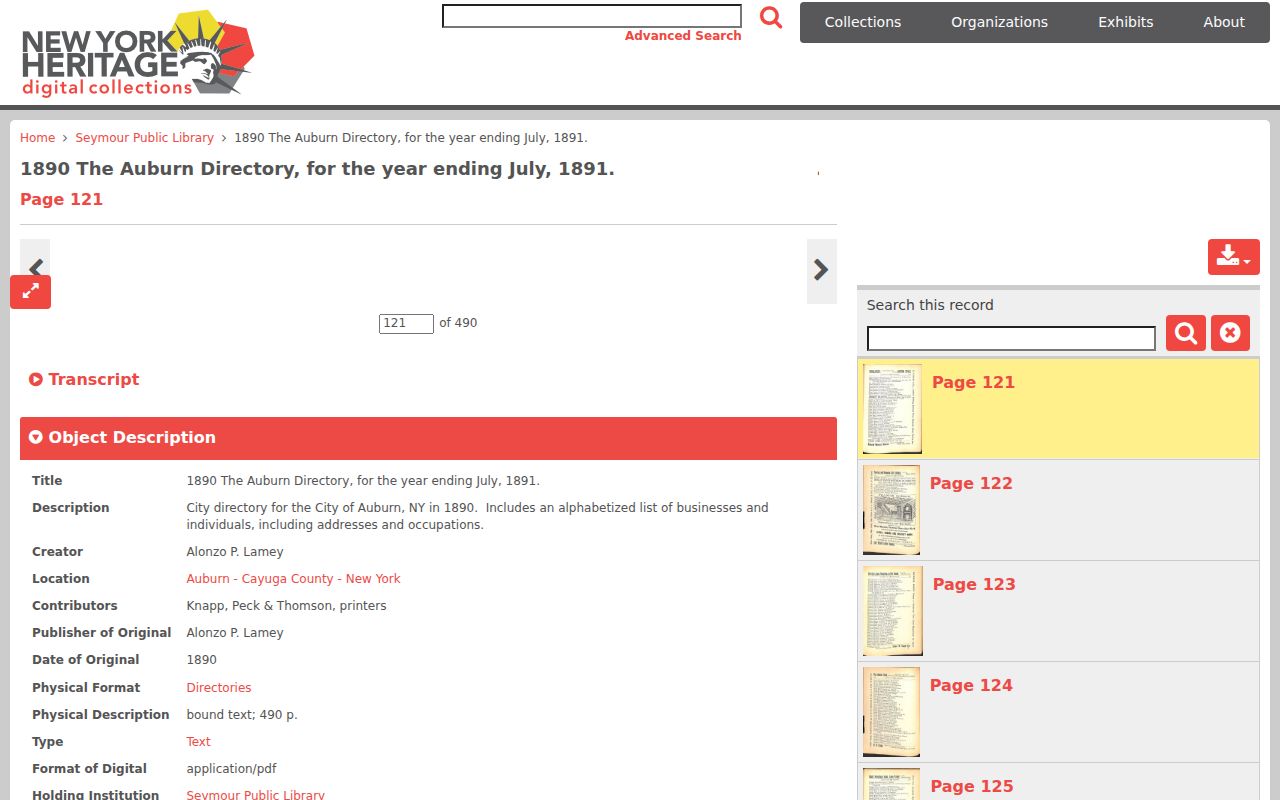
A directory entry supports the exact historical wording and date shown on its page, not a claim about a person’s present address or affiliation.
1910 Auburn Directory Sections
The 1910 Auburn directory has several search paths, not one alphabetical list. Resident alphabetical entries run from pages 27 through 427. Foreign-population sections run from 428 through 457, business material from 458 through 491, the street directory from 517 through 628, and property owners from 631 through 670. Use the resident section for a name-first search and the street section for an address-first question. The property-owner pages can support a historical lead, but a deed remains the stronger ownership record.
The 1915 Auburn directory scan shows later entries with shorthand such as emp and the notation “removed.”
The 1915 conventions record what the compiler printed at the time. “Removed” can signal a move from the compiled entry, but it does not identify a new destination. The foreign-population sections should also be read as the directory compiler’s historical organization of material, not as a modern identity label for a family.
Trace Auburn City Directory Families
A family trail works best as a sequence of dated snapshots. Directories can fill the years between census enumerations, but they do not enumerate every household member. A shared address, widow notation, or recurring initials is a lead to test with a census, deed, obituary, cemetery record, or newspaper notice. The County Historian holds federal census material from 1790 through 1930 and New York State census material from 1855 through 1925, giving Auburn directory research a local archival counterpart.
- Transcribe the first Auburn city directory entry exactly, including initials, street spelling, abbreviations, and its edition year and page.
- Read the same edition’s street section, then its property-owner section, to separate an occupant clue from a property clue.
- Check adjacent available directory years and record changes without replacing the original wording with a modernized version.
- Pair the dated entries with the 1870, 1880, 1900, 1910, and 1920 federal census sequence when those schedules fit the family and date.
- Test a disappearance against obituaries, cemetery records, newspapers, deeds, and Historian files before drawing a conclusion.
Directory compilation dates and census enumeration dates differ. A mismatch may reflect timing, a temporary absence, or an incomplete entry rather than a proven move or family change. Note: Preserve the volume date and page number with every transcription so another researcher can repeat the comparison.
Auburn Directory Address Changes
Auburn’s address history can defeat a literal modern search. The common council ordered street renumbering in 1880 to support the letter-carrier system, and Mechanic Street became Osborne Street in spring 1910. A result that appears to vanish may instead be using an earlier number or street name. Retain the text printed in the directory, then compare it with maps and a historical building record before tying it to a current parcel.
Auburn HistoryForge supplies early-twentieth-century building and address layers, including historical addresses, construction and demolition fields, and annotations. It is useful corroboration for a directory-era address, but its building information does not prove a current occupant.
For a physical-setting check, the verified Auburn Sanborn set is June 1886 and has 23 sheets. A Sanborn image can support a building footprint, use, lot, or street context on its own date. It does not establish who occupied the building. Keeping the directory, map, and modern parcel in separate evidence columns avoids turning a historical address match into an unsupported present-day conclusion.
Auburn Directory Research Fallbacks
When the Auburn city directory shelf stops, the County Historian is the documented archival route. Its holdings include surname files, church records, newspapers, census, maps, architectural files, military material, and grantor/grantee deed indexes. The Historian is at 10 Court Street and can be reached at 315-253-1300. Research is $20 per hour with a two-hour minimum plus $3 postage; copy and watermarked photo-research charges are separate. The mail-only request form asks for the subject or address, spelling variants, relevant dates and places, family details, a primary goal, and a secondary question. The stated turnaround is four to six weeks.
County Historian services describe the research categories and fee structure.
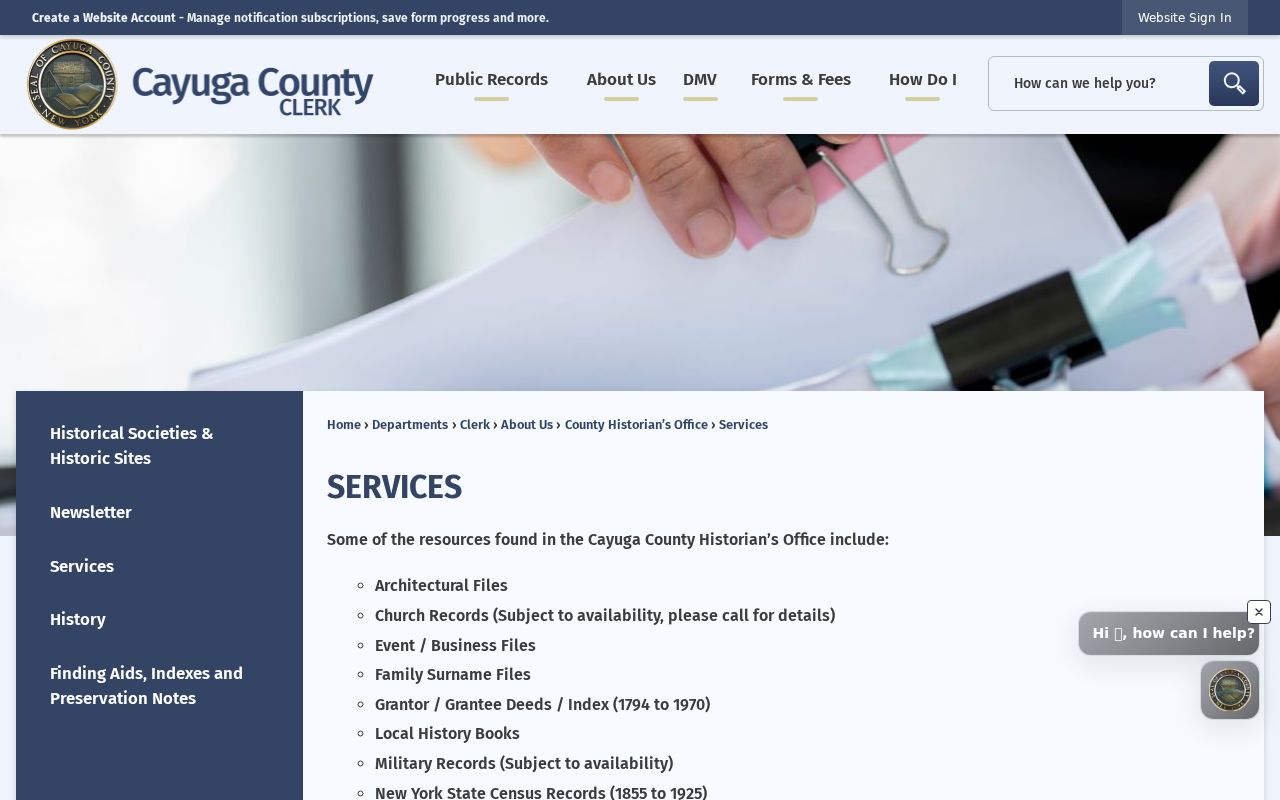
The request route is a good fit for a defined family, building, church, or directory-era question, especially when it includes the original address form and a narrow date span.
The Cayuga County Historical Society collection at Cayuga Museum adds papers, journals, and local accounts from a collection spanning 1876 to 1976.
Museum collection material provides local context for a dated directory finding; it does not replace the directory page, census, or deed that supports a specific historical claim. If a series name or date is unclear, the County Clerk records inventory can help identify the historical book before a request is sent. That level of detail helps the Clerk, the Historian, and library staff determine whether the material is a directory, a deed index, a census record, or an archival file.
Auburn Directory-Era City Files
A historic directory can be paired with a city document only when both records support the same period and question. The City of Auburn archive provides a searchable route to older administrative documents, while the City Clerk routes municipal records, cemetery genealogy, and Freedom of Information Law (FOIL) requests. City FOIL requests go to the Records Access Officer at Memorial City Hall, 24 South Street, first floor, Monday through Friday from 8:00 to 4:00. Submit the city form by email, mail, or first-floor delivery, with the department, date span, record type, preferred delivery format, and a mailing address. The archive or a request may add civic context, but neither is a substitute for the actual Auburn city directory edition.
Auburn Directory Work in 2026
On May 12, 2026, Seymour Library published “1876: A Look at Life in Auburn”, connecting the city’s 150th-anniversary-era history to an 1876 directory and the 1875/76 atlas. The post directs researchers to the digitized directory on NY Heritage. That initiative makes a useful entry point for studying Auburn’s directory era alongside maps, but each entry still needs its original edition and page citation.
Auburn’s river, industrial, and renewal history also explains why a historic address may no longer match a standing building. Directory evidence gains strength when its date, historical street form, and supporting map layer remain distinct.